



If you’re graduating in 2026, you’re walking into a job market that moves fast and asks a lot. Hybrid work is normal. AI shows up in almost every role. And teams look different from the way they did a few years ago.
It’s exciting, but it can also feel noisy. Everyone says “learn AI,” “network harder,” “get certified,” “optimize your resume.” Which of those actually helps you stand out?
Thinking in terms of signal vs noise makes a difference. Signal is what truly predicts success in a role. Noise is everything that looks impressive on the surface but doesn’t say much about how you’ll perform.
When you know the difference between the two, you spend your time on what matters.
This page draws the line between signal and noise in recruitment. As a fresh grad, read on to learn what actually makes you stand out in the hiring market this year.
Signal vs Noise: What Hiring Companies Want
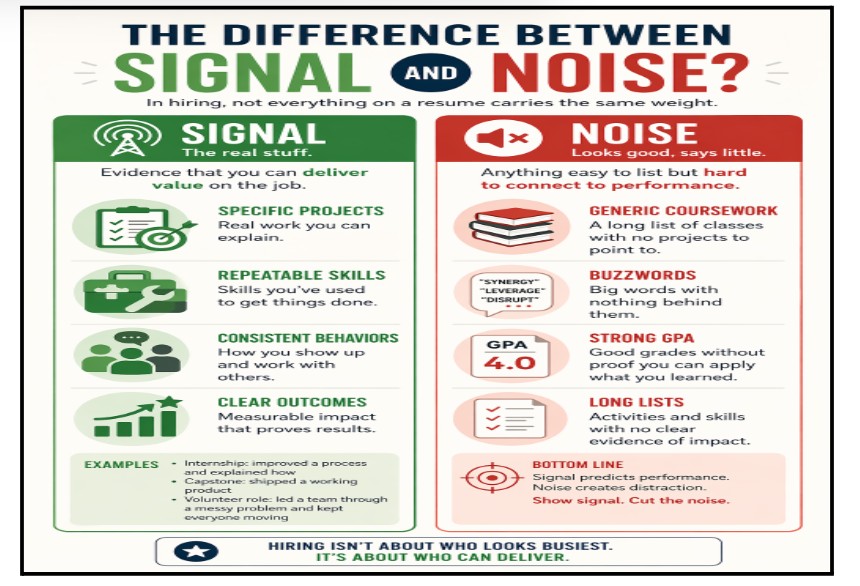
What’s the difference between signal and noise?
- Signal is evidence that you can deliver value on the job. It shows up as specific projects, repeatable skills, consistent behaviors, and clear outcomes. For example:
- The internship, where you improved a process and can explain how
- The capstone, where you shipped a working product
- The volunteer role, where you led a team through a messy problem and kept everyone moving
- Noise is anything easy to list but hard to connect to performance. It’s a long stack of generic coursework with no projects to point to. It’s buzzwords with nothing behind them. For example:
- A strong GPA when there’s no proof that you can apply what you learned in the real world.
Learn from Kashif Ali, Growth Specialist at PsychologySchoolGuide.net. He believes that employers are less interested in what candidates know in theory and more focused on how they apply it in practice.
Ali says, “In education and psychology-related fields, we often see candidates rely heavily on GPA or coursework. But what truly stands out is applied experience…like research and internships. Or real case work that shows how you think and solve problems.
He adds, “Employers want to see how you turn theory into action. That’s the signal. Everything else is just noise.”
What do companies actually want in 2026?
It’s crucial to stay up to date with job market trends in 2026. As a fresh graduate, you have to specifically research what employers are looking for this year. Here’s what companies seek this year:
- Adaptability and learning agility: Roles change quickly and easily. Managers want people who can pick up new tools and shift gears without drama. WEF reports analytical thinking, creative thinking, resilience, digital fluency, and AI literacy as core skills for the near future.

- AI literacy (not just AI hype): You don’t need to build models for every role. However, you should know how to use AI tools responsibly. Not to mention check outputs and explain your choices. LinkedIn’s learning data shows rapid growth in demand for AI-related skills across non-technical roles, too.
- Cross-disciplinary comfort: Finance teams want folks who can query data. Marketers need people who test and learn like product managers. Engineers who can talk to customers move faster. The lines between “technical” and “non-technical” have blurred.
- Human skills (that hold teams together): Communication and collaboration (even conflict resolution) matter even more in diverse teams. Employers increasingly talk about “culture add” and values alignment rather than “culture fit.” This helps keep teams fresh and inclusive.
Take it from Christopher Skoropada, CEO of Appsvio. He claims that the most in-demand candidates in 2026 are those who can operate across roles and adapt quickly to changing environments. Not just specialize in one narrow skill set.
Skoropada explains, “What we’re seeing across teams is a shift toward versatility. The strongest candidates aren’t just technically capable. They can collaborate across functions and adapt to new tools. They stay effective even when things aren’t clearly defined.
He concludes, “When someone can show they’ve navigated ambiguity and still delivered results, that’s the kind of signal hiring managers actually trust.”
Do degrees still matter?
Short answer: yes, but with nuance.
A degree is still a strong signal for many roles. Especially early-career and in regulated fields. Your diploma is more than just a piece of paper. It allows you to use your achievements as motivation in building your career.
On average, higher education correlates with lower unemployment and higher earnings over time. A relevant program with real projects and research can do more than any bullet on your resume.

Wade O’Shea, Founder of BusCharter.com.au, emphasizes that in service-driven industries like transportation and logistics, hiring decisions come down to practical capability. Not just formal credentials.
O’Shea shares, “In our business, a degree can be helpful, but it’s not what ultimately drives hiring decisions. We look for people who can solve real operational problems, communicate clearly with clients, and handle unexpected situations on the ground.
He continues, “Whether that comes from a university program or hands-on experience doesn’t matter as much as being able to prove it. If you have a degree, show us the outcomes it has produced. If you don’t, show us the work as that’s what makes the difference.”
Sure, your academic credentials matter. But if you’ve earned a degree, make it work for you. Highlight capstones, labs, fieldwork, and any measurable impact. If you’re taking an alternative route, make sure your projects are real and visible.
And one small but human note, given our home turf: how you present your achievements matters. That’s where framed diplomas that speak to your credentials come in. A diploma tucked in a drawer is a missed story. But on a profile and even framed behind you on a video call, it can become a credible signal of what you’ve done and where you’re headed.
How To Build Your Profile as a Fresh Graduate
As a fresh graduate, it’s essential to build your portfolio before finding a job in 2026 and establishing your career path. Here’s what you need to do:
- Do projects that solve real problems. Pick problems that matter to a user. A community group, a campus office, or a small business. Ship something. Even a scrappy version.
- Measure what you did. Replace “helped with marketing” with “launched a three-email welcome series that lifted trial-to-paid by 11%.” Numbers travel well.
- Learn AI (like a power tool). Use it to brainstorm, summarize, draft, and analyze, but show your process along the way. Employers like to see how you verify outputs and protect data.
- Build a simple, strong portfolio. One page is fine. Short project blurbs, screenshots, and links. Include a short “how I worked” section for each piece.
- Get feedback in public. Contribute to open source, enter a case competition, publish a short teardown on LinkedIn, Behance, or GitHub. It shows you can take critique.
- Use internships and volunteering strategically. If you can’t land the “perfect” internship, find a scrappy one with real ownership. Scope a project, get agreement on success, deliver it, and ask for a testimonial.
- Network like a person (not a transaction). Reach out to people doing jobs you want. Ask two or three thoughtful questions. Follow up with a note about what you tried based on their advice.
- Cut the noise. Don’t stack five near-identical certificates. One or two plus a real project beats a wall of badges every time.
Gavin Yi, CEO & Founder of Yijin Solution, believes that fresh graduates stand out when they present their work in a structured way. That shows both results and thinking.
Yi suggests, “A simple structure goes a long way: problem, approach, outcome, reflection. Most candidates stop at the outcome, but the reflection is what really stands out. It shows you can think critically, learn from experience, and improve. This is exactly what employers are looking for.”
Examples: What worked for three new grads
It’s not a walk in the park to begin your career after graduation. You need to build your profile first before hitting the job market and navigating your career path. To help you out using clear signals for your chosen path, here are a few examples:
1. Amira, product-minded engineer

2. Diego, English major turned content designer

3. Ji-won, data analyst without a brand-name internship

Final Words
Standing out in 2026 isn’t about collecting every credential. It’s about making real things and measuring what changed. It’s telling that story in a way a busy hiring manager can grasp in a minute. Degrees still matter. So do practical projects and learning agility. And so do the human skills that make teams work. That said, focus on those signals and the rest sorts itself out. And when you’ve earned that diploma, go ahead and frame it. Don’t forget to give it a place in your story. Online, in conversation, maybe even on the wall behind your next video interview!