



You spent years earning the credentials. Then you open your own practice and learn something uncomfortable: almost nobody sees them first.
BrightLocal’s 2026 Local Consumer Review Survey of 1,002 US consumers found that 97% read reviews before choosing a local business, and 41% now say they always read them, up from 29% the year before.
So the first meeting between you and your next patient happens on a phone screen, days before anyone walks through your door.
Here’s the good news. That first meeting is winnable, and most of the work is cheap. Let’s look at what it takes.
What Does a Patient Actually Do Before They Book?
Most people run the same short sequence. They search on a phone, scan the map results, check the star rating and the two or three newest reviews, then tap through the photos. Many decide before they ever reach your website.
That sequence matters more for a new practice than an established one, because you have no word of mouth working for you yet.
A 2026 scoping review in Health Expectations on building trust in new physician relationships found that when no relationship exists yet, people lean on early cues of competence and professionalism to decide whether a provider is worth trusting.
They are looking for reasons to say yes. Your job is to hand them a few.
Why Do Framed Credentials Still Change How People Judge You?
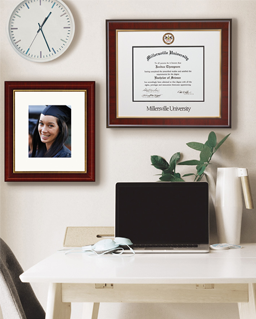
A framed credential is proof that outlives the appointment. Patients cannot verify your training from a search result, but they can read the document hanging behind you. Displayed credentials answer the question most people are too polite to ask out loud, which is whether you are actually qualified to do this.
This is not sentiment. It is the oldest trust signal in professional practice, and it still works because it is specific. A wall that names your school, your degree year, and your state license tells a stranger more in three seconds than a paragraph of marketing copy.
The presentation carries weight too. A document taped inside a plastic sleeve reads as temporary. A properly matted frame reads as permanent, which is exactly the impression a first-year practice needs to give.
For most professionals that means two documents on the wall rather than one:
- Your degree, in a dentistry frame or a legal frame that matches your school
- Your license, in a state seal frame that matches the state you practice in
Church Hill Classics covered the credibility side of this in more depth in how diploma frames help professionals build a credible online presence.
How Does Your Office Wall End Up in Your Google Profile?
Through photos. Your Google Business Profile has a photo gallery, and it is one of the first things people tap after the star rating. Pictures of your real reception area, your team, and the credentials on your wall do the same work online that they do in the room.
Most new practices skip this or upload four blurry phone shots and never return.
Google’s own small business resource reports that customers are 70% more likely to visit and 50% more likely to consider buying from a business with a complete profile.
A short shot list worth doing in one afternoon:
- The exterior, so people recognize the building from the street
- Reception, with your framed credentials in the frame of the shot
- Two or three treatment or meeting rooms
- Your team, faces visible, no stock photos
Retake them every few months. Stale photos age a profile fast.
Which Trust Signals Does Google Actually Weigh?
Google names three in its local ranking documentation: relevance, distance, and prominence. Relevance is how well your services match the search. Distance is how close you are. Prominence is how well known and well reviewed you appear across the web, and it is the one a new practice can move fastest.
Prominence is where credentials, reviews, and consistent business details all end up counting.
Whitespark’s annual Local Search Ranking Factors survey of local search practitioners keeps pointing in the same direction: engagement signals like calls, direction requests, and photo views carry growing weight, alongside review activity.
If you want the full breakdown, Pexnet published a working guide to which local ranking signals carry the most weight and which ones to fix first.
Here is the part that surprises new owners. The offline habits you already have translate almost one to one:
| What you do in the office | Its online equivalent |
| Framed degree and license on the wall | Credentials in your profile photos and bio page |
| Front desk greets people by name | Owner replies on every review |
| Clean, current waiting room | Fresh photos and accurate hours |
| Referrals from a colleague nearby | Links and mentions from local sites |
What Does This Look Like for a Real Practice?
A recent example: SmileCrew, an orthodontic practice in Leander, Texas, was sitting at roughly 100 monthly website visitors. The agency working with them, Pexnet, spent the first two weeks doing nothing but the foundation, which meant rebuilding the Google profile field by field and correcting business listings that disagreed with each other.
Reviews, photos, and page work came after. Three months in, monthly traffic reached about 1,500.
Nothing in that sequence was clever. It was ordinary setup work done in the right order, which is the part most new owners get backwards. Agencies that focus on one field, like the teams doing SEO built for dental practices, tend to run the foundation first for exactly this reason.
What Do New Owners Get Wrong in Year One?
Four mistakes account for most of the damage.
Leaving the profile half finished. No services listed, no hours, no photos. Google cannot recommend what it cannot understand.
Letting your details drift apart. If your practice name or suite number reads differently on your website than on a directory listing, you have handed Google a reason to trust you less.
Buying reviews. The FTC’s rule on fake reviews and testimonials took effect in October 2024 and carries civil penalties of up to $51,744 per violation for knowing violators. It also covers reviews written by staff without disclosure. Not worth it.
Waiting to ask for the first review. Your happiest patients are happiest on the day of the appointment, not three weeks later.
How Long Before Any of This Starts Working?
Expect small movement in the first two months and something you can measure between months three and six. Profile fixes and photos show up fastest. Reviews and local mentions build slower because they depend on real people doing real things.
If you work from home rather than a leased office, the same rules apply with one change. You set a service area instead of a street address, and your credentials do even more of the trust work because there is no reception room to make an impression. Church Hill Classics has a good piece on turning a home office into a space that reflects your career.
Frequently Asked Questions
Do framed credentials really affect whether someone books?
They affect perception, which affects booking. People deciding between two similar providers look for signals of permanence and legitimacy, and displayed credentials are among the clearest available in a first visit or a photo.
Should I display my degree or my license?
Both, where you can. The degree shows training. The license shows current authority to practice in that state. Together they answer two different questions a new patient has.
How many photos should a new practice upload to Google?
Start with 10 to 15 real photos covering the exterior, reception, working spaces, and your team. Then add a few every month so the profile keeps looking active.
Is it worth asking patients to mention my credentials in reviews?
No. Scripting reviews is a fast way to look manufactured, and incentivized reviews now fall under FTC rules. Ask for honest feedback and let people say what they noticed.
When should a new practice hire help instead of doing this alone?
The profile, photos, and review habit are all doable yourself. Consider outside help once you need location pages, ongoing content, or link building, which take time most owners in year one do not have.
The Short Version
Trust is not built at the first appointment. It is built in the ninety seconds before someone decides to call you, and again in the moment they sit down and see what you put on your wall.
Get both right and the practice stops feeling new to everyone but you.
If your credentials are still sitting in the tube they were mailed in, that is the easiest fix on the list. Find a frame that matches your school or your state license and get them on the wall before your next patient does.