





You worked hard for that degree. It’s more than paper with fancy lettering. It’s proof of late nights and long days. It’s the start of a career you care about.
Framing your diploma or certification protects it. It shows clients, patients, customers, or colleagues what you’ve accomplished. But how you frame it matters.
In law, medical, and business fields, trust and credibility count from the first handshake. So, a well-framed degree on the wall sends a clear message about your standards.
This page shares some framing tips for your law, medical, or business degree. Read on to learn what materials to use to protect your document and the style choice to make for different professions.
Why Frame Your Professional Degree?
A diploma frame protects your achievement forever. It protects your piece of paper from UV light, moisture, dust, and other harsh elements.
Paper degrades over time when exposed to light and humidity: The fibers break down, colors fade, and edges get brittle.
There’s a practical side, too. When clients or patients walk into your office, they look around. They notice what’s on the walls. Guess what? A framed degree signals competence before you even say a word.
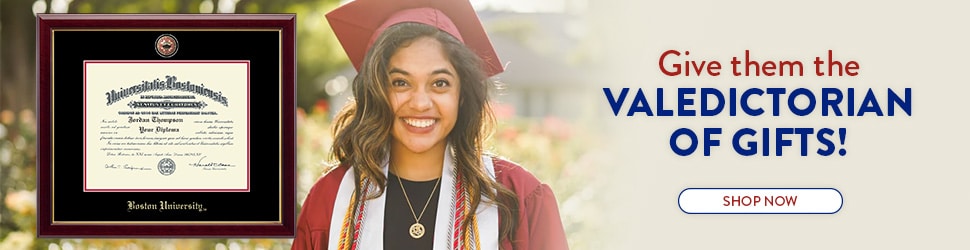
Take officially licensed custom college diploma frames from Church Hill Classics, carefully handcrafted in the U.S. They are proof of your academic achievements, protected by sturdy frames that could, yes, last a lifetime.
How To Choose the Right Frame for Your Degree
It’s crucial to pick a frame the way you choose a college degree that aligns with your personality.
Sure, the right combination of materials and design protects your diploma. However, it also complements your professional environment.
As you decide, here’s what to keep in mind:
Frame materials
Most diploma frames use wood or recycled wood mouldings. Sometimes composite materials or metals, although these are not archival or considered safe for long-term preservation.
- Wood frames feel substantial and traditional. Solid hardwoods or 100% recycled wood frames work in almost any office. If you care about sustainability, opt for Church Hill Classics frames, which are certified eco-friendly.
- Frames with metal finishes look modern and clean. Opt for metal wood finishes, from matte gold and pewter to brushed silver and champagne. These fit well in contemporary decors and are archival-quality, since they’re made with wood and not metal or plastic.
- Composite frames (such as MDF) cost less and mimic wood grain but are not archival-quality because they contain harmful acids that can damage documents. They are not recommended for use.
Heed our advice: Start with an archival-quality frame that suits your space.
- A walnut frame might suit a traditional law office.
- Matte black metal might work better in a startup office or modern clinic.
Glass and acrylic options
What covers your diploma affects how it looks and how long it lasts. You’ll choose between UV-protective glass and acrylic.
- Glass resists scratches and stays clear. Regular glass reflects light, which can be heavy. However, you can upgrade to anti-reflective and UV-filtering versions.
- Acrylic weighs about half as much as glass and won’t shatter. That makes it safer in busy spaces like clinics and exam rooms. It scratches more easily than glass. However, a higher-end acrylic includes UV filtering and resists static.
Learn from Adrian Iorga, Founder and President of Stairhopper Movers. He has handled the transport of delicate and high-value items, including framed artwork and credentials. He’s seen firsthand how improper materials can lead to damage over time.
Iorga says, “UV-filtering glass or museum-quality acrylic isn’t optional if you want your diploma to last. Pair that with acid-free matting…and you prevent yellowing and fading for decades.”
He wraps up, saying, “Professional framing costs more upfront, but it’s cheaper than replacing a damaged degree.”
Placement matters, too. Don’t hang your diploma in direct sunlight or under bright halogen lights. If you’re adding dedicated lighting, use LEDs. They produce almost no UV and less heat than older bulbs.
Matting and design considerations
Matting creates a gap between your diploma and the glass. That space prevents sticking and keeps the paper flat. That said, use acid-free, lignin-free mat board and backing. Why? Acidic materials cause yellowing over time.
Color and texture should complement your degree’s seal and lettering. White or off-white (even soft neutral mats) work almost anywhere. Have a peek at the mat color options from diplomaframe.com.
Double matting lets you add a thin accent in your school color without overwhelming the design.
- In a modern office, white matting with a narrow frame looks clean.
- In traditional settings, cream matting with subtle linen texture and a deep wood frame reads as established and calm.
Top Framing Tips for Your Degree
Framing your diploma is one way to celebrate your academic achievements with a personalized keepsake.
Likewise, it signals the first step in your career path, providing tangible motivation to succeed.
Whether in the legal, medical, or business field, here are framing tips for your degree:
For law degrees
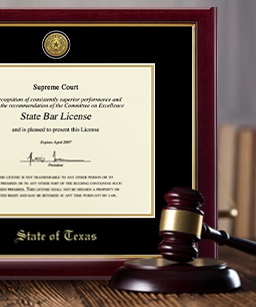
It’s essential to observe credential framing etiquette. Law offices run on trust and attention to detail. There’s a reason deep wood tones and clean lines dominate in law firms.
Take it from Eric Yohay, CEO and Founder of Outbound Consulting. He works closely with professionals in high-trust industries and understands how visual cues shape perception. He emphasizes that even small presentation details can influence how credibility is judged in client-facing environments.
Yohay explains, “In law, everything you display says something about how you work. Dark wood frames with gold accents stick around because they look stable and serious. Adding a school seal or a simple nameplate keeps it personal without losing professionalism.”
A few practical tips:
- Go with hardwood or 100% recycled wood. Think of mahogany or walnut. A gold fillet or thin inner beading can echo the foil on your diploma.
- Keep matting simple. Off-white or black with a narrow accent in your school color looks polished.
- Have consistent spacing. If you’re hanging multiple credentials, line them up evenly. Straight lines look intentional.
- Make sure to declutter. One small accent, like a nameplate or embossed emblem, is enough. Too many details clutter the wall.
For medical degrees
Medical offices should feel clean. They should be organized and welcoming.
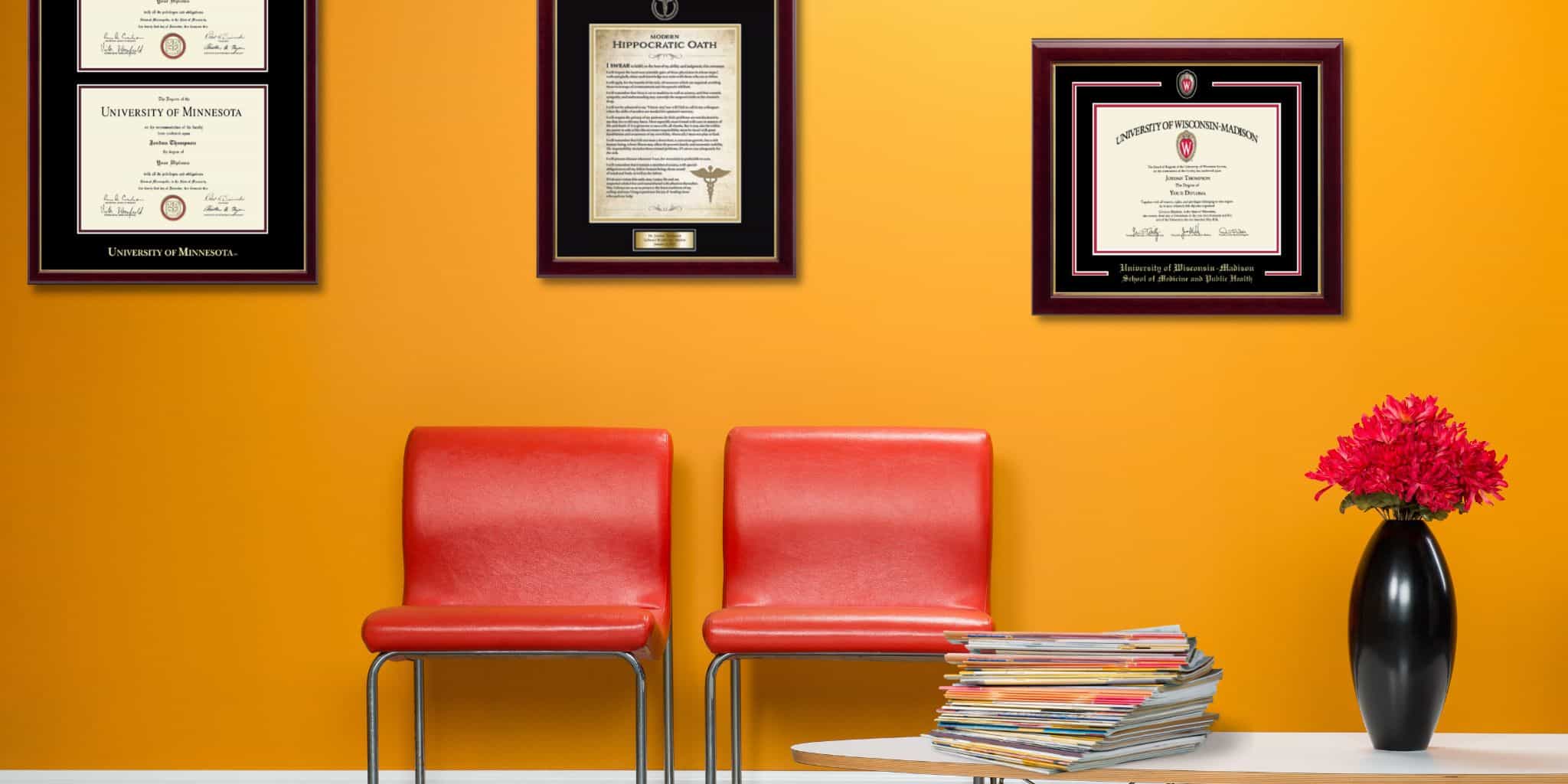
Framing sets that tone fast. How? See the medical school certificate frame from diplomaframe.com:
Nick Wiese, Regional Vice President of Priority One Heating & Air Conditioning, works with healthcare facilities where cleanliness and safety standards are closely managed. He understands how even small environmental details contribute to patient comfort and trust.
Wiese shares, “Medical professionals do better with clean, simple frames. Silver or brushed metal with white matting makes the space feel ordered and clear. Patients notice those details. They connect them with precision and care.”
Acrylic works well in clinics. It’s lightweight and doesn’t shatter if bumped. Museum-grade acrylic reduces glare and blocks UV rays, while staying easy to clean.
If you’re hanging diplomas in patient rooms or busy hallways, acrylic is safer. Take note:
- Stick with bright, simple matting.
- Avoid heavy textures.
- Hang frames at eye level where patients can see them while they wait.
For business degrees
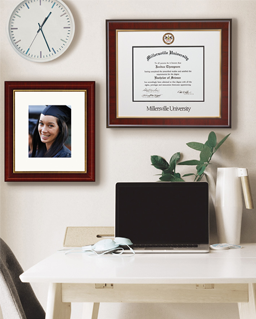
Business settings vary more than law or medicine. Your degree might hang in a startup loft. A corporate conference room. Or a home office that doubles as your Zoom background. The frame should fit that range.
Wade O’Shea, Founder of BusCharter.com.au, works with a wide range of corporate clients. He understands how workspace presentation reflects brand identity. He cites that in business environments, design choices often signal how a company thinks and operates.
O’Shea notes, “Business today moves fast and crosses borders. Contemporary frames in sleek metal or sustainable materials show you’re thinking ahead. Clients notice, and it starts good conversations about how you approach problems.”
Cases in point:
- If your space is modern, try thin matte black or brushed aluminum with a wide white mat. It looks sharp and editorial, like a well-designed report. Want warmth without going traditional? Light oak or espresso gives you a clean, sustainable feel.
- If you work with global teams, simple, universal design translates better than ornate frames. Share the wall with one or two other pieces, like a framed mission statement or an award. On video calls, it looks confident without feeling cluttered.
DIY Framing vs. Professional Framing Services
Deciding between DIY and professional framing comes down to your budget and time. Not to mention how much risk you’re willing to take. While DIY can be cost-effective, proper framing requires specific materials and techniques to avoid long-term damage. That said, here’s how to weigh your options:
DIY framing
If you’re handy and want to save money, DIY can work. However, you’ll need the following:
- A frame sized exactly to your diploma
- UV-filtering glass or acrylic
- Acid-free mats and backing
- Archival-quality matting and mounting materials
- Mounting corners or hinges
The risk is that small mistakes, like using tape or skipping a dust seal, can damage the diploma over time. Diplomaframe.com offers custom framing options. They let you create your own frames for your diploma or certificate.
Professional framing
Professional framers like Church Hill Classics know archival methods and the keys to long-term document preservation. They can recommend the right glazing for your lighting and cut custom mats with clean margins.
In fact, they already know what size frame you need based on your specific school and graduation year. That saves time and reduces mistakes. It’s especially helpful if your degree is an odd size. Or if you want custom details like a school emblem or nameplate.
Church Hill Classics’ professional framing:
- Uses UV-filtering glass or museum-grade acrylic
- Offers acid-free, lignin-free mats and backing materials
- Allows you to customize wood mouldings, mat colors, and glass options to your liking
- Has easy-to-remove backings, so that you can update or remove your degree as needed
- Includes a foolproof hanging system that ensures frames sit securely and straight on the wall
Costs vary by size and glazing. UV protection and anti-reflective glass add to the price. However, they make a noticeable difference in clarity and longevity. Think of it as maintenance on something you use every day.
Final Note
A framed degree protects something you earned. It gives your space the right kind of presence. To wrap up:
- In law, go traditional with rich woods and subtle accents.
- In medicine, keep it clean with brushed metals, white matting, and low-glare acrylic.
- In business, match your frame to your brand, whether that’s modern and global or warm and grounded.
Good archival materials mean your credentials will look strong in twenty years. Ultimately, small choices now make a real difference later.
Ready to find a frame that fits? You can explore options and customize details at diplomaframe.com.