







If you graduated into a world where a diploma was your golden ticket to a higher salary, you’re not imagining things. For decades, degrees reliably opened doors and bumped paychecks.
However, 2026 looks different. AI is everywhere. More companies are hiring for skills. And short, targeted learning has gone mainstream.
The questions are: Do degrees still boost salary growth? Or has something fundamental shifted? Read on to find out the answers to these crucial questions.
Historical Perspective on Academic Credentials and Salary Growth
For a long time, the logic was simple: more education, more pay.
The U.S. Bureau of Labor Statistics has tracked this for years. Their Education Pays data still shows a clear earnings gradient by educational level. Bachelor’s degree holders out-earn those with a high school diploma in median weekly earnings and face lower overall unemployment rates.
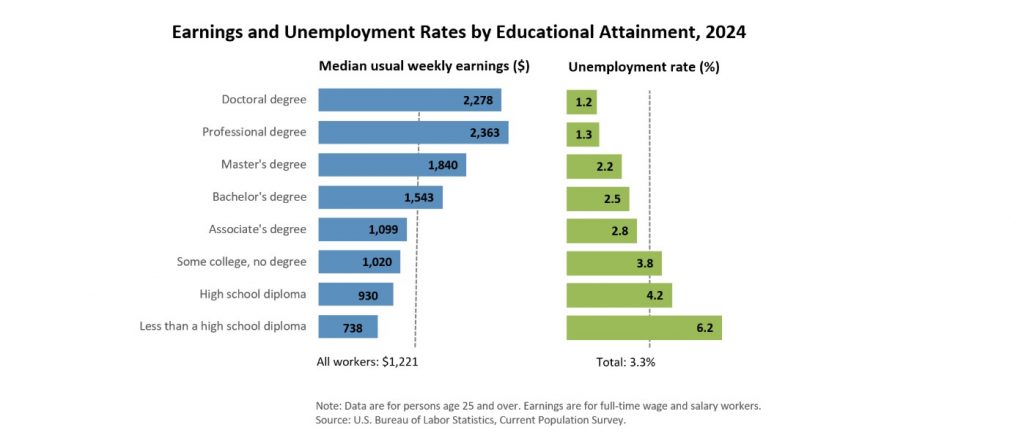
That pattern underpinned family advice and school counseling. Not to mention even employer norms.
Technology reshaped work, though. And two things started bending the curve:
- More roles became “skills-forward.” Your portfolio and hands-on competence mattered as much as coursework.
- The cost of degrees kept rising. People started asking harder questions about payback periods and opportunity costs.
Current Trends in Education and Employment
Jump to 2026, and the picture is messier. See the employment trends below:
- Proof of ability travels faster than it used to.
- Hiring platforms and assessments make your skills legible.
- Online learning makes it easier to upskill without stepping off the career ladder.
- Apprenticeships have scaled in the United States.
According to the Department of Labor’s statistics on Registered Apprenticeship, over 600,000 active apprentices in nearly 27,000 registered apprenticeship programs have been reported in recent years.

On the employer side, skills-first hiring has gained ground.
LinkedIn’s report documented the rise of skills-based practices across industries since 2019. Nearly 20% of job postings no longer require a degree. More employers now prioritize skills over academic credentials. Degrees aren’t irrelevant; they are one signal among several.
People are mixing and matching credentials now: short courses, industry certifications, project-based proof, all carrying weight.
Take it from Wade O’Shea, Founder of BusCharter.com.au. He has encouraged employees to transition careers through proper training and certification. Not to mention practical experience.
O’Shea says, “In our industry, those who move up fastest combine the right certifications with real-world experience. We’ve seen drivers step into dispatch or operations after completing transport management training and gaining hands-on experience. When your credentials match business needs, salary growth usually follows much faster.”
Degrees still dominate in fields with licensure or patient safety at stake. Think medicine, nursing, engineering, and education. In software, design, marketing, operations? Experience and verifiable skills can put you on equal footing, especially early on.
The Role of Degrees in Different Sectors
Technology
In software and data roles, degrees help but don’t define the ceiling. Employers look at the following: code repositories, shipped projects, cloud certifications. Starting salaries often track demonstrated proficiency rather than pedigree.
For instance, a vacation rental website builder can step into more technical roles by showing live projects and performance improvements. Work, such as building booking flows, optimizing site speed, integrating tools, and connecting APIs, proves job-ready skills. That kind of hands-on output carries more weight than a title alone.
Another case in point: we’ve also seen customer support reps shift into DevOps after earning an AWS cert and doing real-world automation work. Their pay moved quickly once they proved they could handle on-call rotations. Show, don’t tell.
Healthcare
Credentials are nonnegotiable when patient outcomes are on the line. Registered nurses must meet strict educational and licensure requirements. The median pay for RNs is $93,600 per year, according to the Occupational Outlook Handbook.

Stackable credentials matter here, too. An RN-to-BSN can expand options and raise pay ceilings. Meanwhile, advanced practice degrees (such as NP or CRNA) often lead to substantial salary increases.
An intensive outpatient program, for example, relies on licensed professionals to deliver evidence-based care. Roles, such as nurses and clinical supervisors, require specific credentials and supervised training to ensure patient safety. In this field, qualifications aren’t optional as they directly shape outcomes and earning potential.
Business
In finance and corporate strategy, degrees still shape early opportunities. An MBA from a top program can open doors to high-paying roles. But the payoff varies. We’ve seen analysts leapfrog the MBA by pairing hands-on P&L responsibility with certifications in analytics or product management.
Tom Rockwell, CEO of Concrete Tools Direct, runs a business offering pro-grade concrete equipment. He shares, “In business roles, especially around operations, the fastest growth often comes from pairing hands-on responsibility with targeted upskilling.
Rockwell continues, “We’ve seen professionals in equipment and tools businesses take short certifications in analytics or product management. These professionals immediately apply them to pricing and sales decisions.
He caps, saying “You’re earning while you learn. Ultimately, that real-world application is what drives compounding career growth over time.”
Skilled trades
Trades offer a different ladder altogether. Electricians typically earn while they learn through apprenticeships. The median pay for electricians is $62,350 per year, according to the BLS.

Many command more with specialized experience, overtime, and leadership roles. You don’t buy your way into this field with tuition. You earn your way up.
Learn from Mike Miller, General Manager at Elkhorn Heating, Air Conditioning, Plumbing & Electrical. He claims that skilled trades reward progression through hands-on experience rather than formal tuition.
Miller explains, “In HVAC, electrical, plumbing work, all rolled into one: you start by learning on the job through apprenticeships and build your income as your skills grow. The more complex systems you can handle, the higher your earning potential becomes. It’s a field where experience and reliability directly translate into advancement.”
Quantitative Analysis of Degree ROI in 2026
The BLS Education Pays chart consistently shows a meaningful earnings premium for higher levels of education. Translate median weekly earnings to annual terms. The gap between a high school diploma and a bachelor’s degree typically amounts to tens of thousands of dollars per year.
Costs matter just as much.
According to the College Board’s Trends in College Pricing, published tuition and fees averaged about $11,950 at public four‑year in‑state institutions and $45,000 at private nonprofits. Before accounting for aid. Room and board add more to the bill. Net price (the real out-of-pocket after grants and scholarships) is what you need to calculate ROI.

The field of study tilts the math.
Georgetown University’s Center on Education and the Workforce found that lifetime earnings differ widely by major. They figured that, on average, bachelor’s degree holders out-earn high school graduates over a career horizon.

STEM and healthcare majors tend to see faster payback periods. The humanities and arts can also offer strong, durable careers. However, the return often arrives later or depends more on graduate study or niche expertise.
A quick mental model for payback windows:
- Low-cost credential + high-demand skill = payback in months, not years, especially if you keep working while you learn
- In-state public bachelor’s in a high-earning field = payback within a few years of graduation if you maintain momentum
- Private degree with high borrowing + lower-earning field = longer payback, improved by geographic mobility, networking, and additional skills
The Changing Value of Degrees: Employer Perspectives
Employers are recalibrating. Many companies are reimagining their compensation structures.
Candidates who demonstrate proficiency through portfolio work or industry certifications often command the same starting salaries as traditional degree holders. What matters most is their ability to solve real problems and adapt quickly. This shift has expanded the global talent pool dramatically while maintaining quality.
In fact, the Burning Glass Institute has documented a “degree reset.” The report shows many employers have dropped four-year degree requirements for a range of middle- and high-skill roles. They are focusing instead on demonstrated skills and experience.
See the distinction between structural and cyclical degree resets below:

In IT, cloud, cybersecurity, and data, certifications paired with hands-on work often signal readiness more clearly than transcripts. Skillsoft’s IT Skills and Salary reports also point to consistent wage premiums for certified professionals and faster advancement in certain domains.
Looking Forward: The Future of Academic Credentials
Where are we headed? Toward portfolios, not single bet-the-farm credentials.
By 2030, we’ll see hybrid credentials becoming the norm. Combinations of academic theory, practical application, and AI-verified competencies.
Forward-thinking professionals are already building credential portfolios rather than relying on single degrees. The winners will be those who can demonstrate both depth of knowledge and breadth of adaptability.
AI is accelerating this.
When tools can draft code or analyze data with a single click, the premium lies in context and judgment. That doesn’t erase the value of a degree. It changes what the degree needs to do for you: sharpen your thinking and build your network. Not to mention anchor a foundation you can extend with job-relevant learning.
For instance, TRT online training (for testosterone replacement therapy) combines medical theory with practical learning. A clinician might study hormone protocols and patient screening online while continuing to apply those skills in real consultations. It’s a simple way to build credentials while staying active in practice.
If you’re planning your next move:
- Map the roles you want to your current skills and the gaps that matter most.
- Choose the lightest-weight credential that closes the most valuable gap.
- Keep earning while you upskill whenever possible.
- Track demand signals: job postings, pay bands, new tools adopted by teams you want to join.
Wrapping Up
Degrees still boost earnings, especially over the long run and in licensed fields. However, the market in 2026 rewards people who continually add evidence of their skills.
For many careers, the best return comes from mixing foundational education with short, targeted learning you can apply on the job right away. Your diploma might be the sturdy frame. Your certifications and projects are the living gallery inside it.
If you’re weighing options, take an afternoon to map your goals to the credentials that actually advance your salary in your field. Also, compare pay bands and look up program costs. Plus, think about the hidden cost of stepping away from work.
When you do choose a path (degree, certification, or a smart combo), showcase it well. Ultimately, you’ll find ideas and resources to honor your hard-earned credentials at diplomaframe.com. Shop now to find the right frames!